Research Meeting Visiting Speaker: Shoufu Yin
September 24, 2025, 10:30 am to 12:00 pm
This Research Meeting features a presentation by visiting speaker Shoufu Yin. Dr. Yin is an Assistant Professor in the Department of History at the University of British Columbia. His research interests include intellectual and political cultures of China as well as the global histories of political thought and imagination. He is finalizing two book manuscripts: The China That Could Have Been: Sinitic Rhetoric and the Search for a Better World, 1100–1600, and A Foundation of Modern Democratic Thought: From Weibo to Tongchuanfu, 700–1200. His research articles have appeared in several journals, including the American Political Science Review, Journal of the History of Ideas, and History of Political Thought.
Title: “A Foundation of Modern Democratic Thought: From Weibo to Tongchuanfu”
Speaker: Shoufu Yin, Assistant Professor, Department of History, UBC
Date: September 24th
Time: 10:30 a.m.--12:00 p.m.
Location: Buchanan Penthouse
RSVP: https://forms.gle/uSpHVZzKyHVHPXNy6
Abstract:
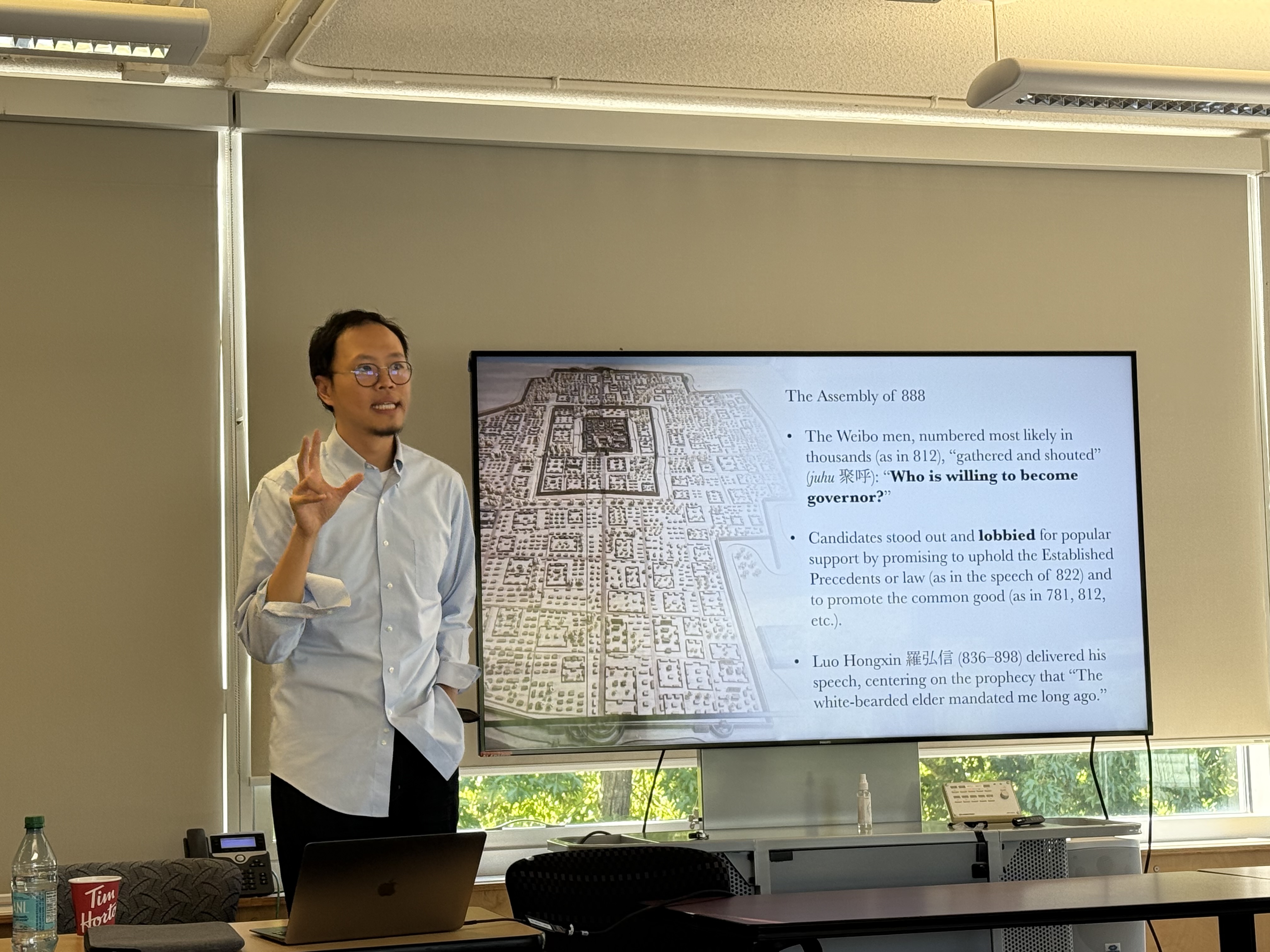
During the long ninth century, in the polity of Weibo (present-day north China), nearly ten thousand men governed themselves collectively. They chose their governor by consensus and debated decisions of war and peace. To this end, they delivered speeches to introduce proposals, clapped their hands to show approval, and wept together in moments of difficulty. By the mid-twelfth century, Weibo-like polities had vanished. Yet a new model of popular political participation emerged—one that “treats the policy chosen by the majority [of the population] as the proper” one to implement. Following this principle, in the Tongchuanfu Circuit (present-day Sichuan), all taxpaying units—namely, 333,700 households representing a population of 1.5 million—voted in the following way: Each household, regardless of whether headed by a woman or a man, signed their preferred policy; after signatures were meticulously counted, each prefecture and county implemented the majority choice, with additional measures devised to assist the minority.
This talk—based on the book manuscript of the same title—traces the transition between two ideal-type forms of governance: Weibo, where collective political action was direct, face-to-face, and limited to privileged men within a small polity; and Tongchuanfu, where women and men make choices through the mediation of a centralized bureaucratic state—one that delineated districts, processed paperwork, employed statistics, implemented the majority will, and enacted measures to protect minority interests. It reveals how methodological insights gained from Weibo to Tongchuanfu can help us rediscover critical moments of democratization worldwide—from the early modern era to the global socialist 1980s. Ultimately, it concludes that the forgotten histories from Weibo to Tongchuanfu have the potential to offer a new framework that transforms how we perceive democracy—its global past, fractured present, and shared future.